


![[pdf]](icons/pdf.png)
|
|
|
|
| A second-order fast marching eikonal solver | |
|
The leading term in the computational cost of the fast marching
algorithm comes from the first step:
choosing the point on the wavefront with the smallest traveltime.
Consequently, the cost should not depend strongly on the order of the
finite-difference stencil, but rather the sort algorithm used.
Heap sorting has a cost of  , and so in principle, with this
algorithm, the fast marching method has a cost of
, and so in principle, with this
algorithm, the fast marching method has a cost of  .
.
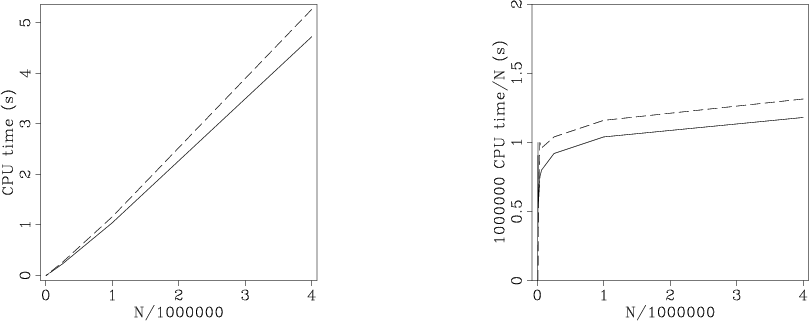
The left panel of Figure 4 shows a plot of CPU time
against  for the same models as Figure 2.
The time shown is elapsed (wall clock) time on a 300 MHz Pentium II.
For the largest model computed here, the second-order code takes 11%
longer to run than the first-order code, and this percentage decreases
as increases.
for the same models as Figure 2.
The time shown is elapsed (wall clock) time on a 300 MHz Pentium II.
For the largest model computed here, the second-order code takes 11%
longer to run than the first-order code, and this percentage decreases
as increases.
Because  grows slowly compared to , the plot of CPU time
against is dominated by the linear term. The right panel in
Figure 4 addresses this issue by showing CPU time
divided by versus . On this graph, the behaviour is
clearly visible.
grows slowly compared to , the plot of CPU time
against is dominated by the linear term. The right panel in
Figure 4 addresses this issue by showing CPU time
divided by versus . On this graph, the behaviour is
clearly visible.
|
|---|
|
times
Figure 4. Elapsed CPU time vs. the number of grid points, , for first-order (solid line) and second order (dashed
line) eikonal solvers. Left panel shows CPU time vs . Right
panel shows CPU time vs . vs .
|
|
|
|
|
|
|
| A second-order fast marching eikonal solver | |
|