![[pdf]](icons/pdf.png)
|
|
|
|
| Acoustic Staggered Grid Modeling in IWAVE | |
|
The IWAVE acoustic staggered grid scheme implements the Perfectly
Matched Layer (PML) approach to absorbing boundary conditions, in one of the
simpler of its many guises (a split field approach -
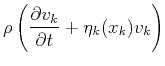
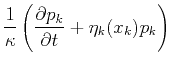
(Hu et al., 2007)). After some manipulation, the acoustic PML system
for the physical velocity  and an artificial vector pressure
 takes the form
 th component of the attenuation profile vector
  depends
only on
depends
only on  , and can be stored as a collection of 1D objects. Ordinary acoustic
wave propagation takes place where
, and can be stored as a collection of 1D objects. Ordinary acoustic
wave propagation takes place where
 , and if the
components of the vector pressure are all the same in this zone,
then they remain the same there, and any one of them may be regarded
as the same as the physical pressure field. Outside of the physical
domain, where waves are to be attenuated,
, and if the
components of the vector pressure are all the same in this zone,
then they remain the same there, and any one of them may be regarded
as the same as the physical pressure field. Outside of the physical
domain, where waves are to be attenuated,  should
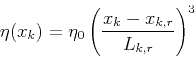
ibe positive; at the boundary of the physical domain, it should vanish to positve order. We
elected to make cubic in distance to the boundary: for
a PML layer of width
should
ibe positive; at the boundary of the physical domain, it should vanish to positve order. We
elected to make cubic in distance to the boundary: for
a PML layer of width  , beginning at
  along the th
coordinate axes,
along the th
coordinate axes,
 signifies a free surface boundary face. Any face of
the boundary may be assigned a zero-pressure condition () or a
PML zone of any width (
signifies a free surface boundary face. Any face of
the boundary may be assigned a zero-pressure condition () or a
PML zone of any width ( ).
).
Many implementations of PML, especially for elasticity, confine the extra PML fields (in this case, the extra pressure variables) to explicitly constructed zones around the boundary, and use the standard physical system in the domain interior. We judged that for acoustics little would be lost in either memory or efficiency, and much code bloat avoided, if we were to solve the system (3) in the entire domain.
Considerable experience and some theory
(Moczo et al., 2006; Hu et al., 2007) suggest that the system 3 will
effectively absorb waves that impinge on the boundary, emulating free
space in the exterior of the domain, if the PML zones outside the
physical domain in which are roughly a half-wavelength
wide, and  .
.
A simple 2D example illustrates the performance of this type of
PML. The physical
domain is a 1.8 x 7.6 km; the same domain is used in the experiments
reported in the next section. A point source is placed at  =40 m,
 km, with a Gaussian derivative time dependence with peak
amplitude at about 5 Hz, and signifcant energy at 3 Hz but little below. The acoustic velocity is 1.5 km/s throughout
the domain, so the effective maximum wavelength is roughly 500 m. The
density is also constant, at 1 g/
km, with a Gaussian derivative time dependence with peak
amplitude at about 5 Hz, and signifcant energy at 3 Hz but little below. The acoustic velocity is 1.5 km/s throughout
the domain, so the effective maximum wavelength is roughly 500 m. The
density is also constant, at 1 g/ . A
snapshot of the wavefield at 1.2 s after source onsiet
(Figure 1), before the wave has reached the boundary of the
domain, shows the expected circular wavefront. At 4.0 s, a simulation
with zero-pressure boundary conditions on all sides of the physical
domain produces the expected reflections, Figure 2. With
PML zones of 250 m on the bottom and sides of the domain, so that only
the top is a zero-pressure surface, and
. A
snapshot of the wavefield at 1.2 s after source onsiet
(Figure 1), before the wave has reached the boundary of the
domain, shows the expected circular wavefront. At 4.0 s, a simulation
with zero-pressure boundary conditions on all sides of the physical
domain produces the expected reflections, Figure 2. With
PML zones of 250 m on the bottom and sides of the domain, so that only
the top is a zero-pressure surface, and  , the wave and its
free-surfacec ghost both appear to leave the domain
(Figure 3, plotted on the same grey scale). The
maximum amplitude visible in Figure 2 is roughly
, the wave and its
free-surfacec ghost both appear to leave the domain
(Figure 3, plotted on the same grey scale). The
maximum amplitude visible in Figure 2 is roughly
 , whereas the maximum amplitude in Figure
3 is
, whereas the maximum amplitude in Figure
3 is
 . The actual reflection
coefficient is likely less than
. The actual reflection
coefficient is likely less than  , as the 2D free space field
does not have a lacuna behind the wavefront, but decays smoothly, so
the low end of the wavelet spectrum remains.
, as the 2D free space field
does not have a lacuna behind the wavefront, but decays smoothly, so
the low end of the wavelet spectrum remains.
It is not possible to decrease the PML layer thickness much beyond the
nominal longest half-wavelength and enjoy such small
reflections. Figure 4 shows the field at 4.0 s with
PML zones of width 100 m on bottom and sides, and an apparently
optimal choice of  . The maximum amplitude is
 , and a reflected wave is clearly visible at the same grey scale.
|
|
|
|
| Acoustic Staggered Grid Modeling in IWAVE | |
|