


![[pdf]](icons/pdf.png)
|
|
|
|
| Homework 2 | |
|
scons movie.vpland observe a movie illustrating the slow data sorting algorithm. The algorithm is implemented in the slow_sort function in the file sorting.c.
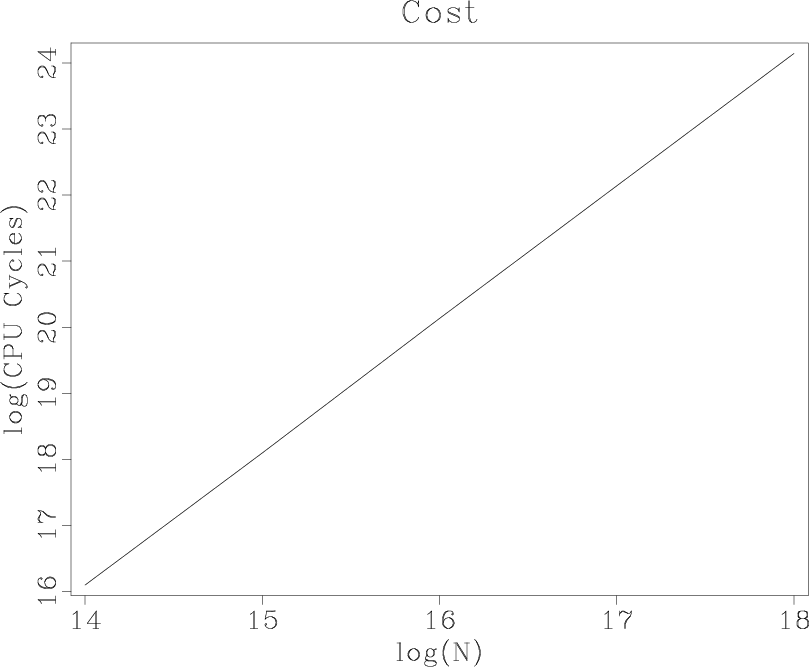
scons viewto compute the cost of slow sorting experimentally. The output is shown in Figure 1.
|
cost
Figure 1. Experimental cost of slow sorting. The logarithm of the cost is shown against the logarithm of the data size. |
|
|---|---|
![[scons]](icons/configure.png)
|
If we approximate the cost as
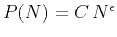 , what is the value of
 observed in the picture?
scons movie.vplto observe a change in the sorting movie. Debug your changes to the program if necessary.
scons viewto observe the change in the algorithm cost. What is the new experimental value of
?
#include <time.h>
#include <rsf.h>

static int na, nmovie=0;
static float *arr;
static sf_file movie;

static void write_movie(void)
{
    if (NULL != movie)
	sf_floatwrite(arr,na,movie);
    nmovie++;
}

static void slow_sort(int n, float* list)
{
    int k, k2;
    float item1, item2;

    for (k=0; k < n; k++) {
	write_movie();

	item1 = list[k];
	/* assume everything up to k is sorted */
        for (k2=k; k2 > 0; k2-) {
            item2 = list[k2-1];
            if (item1 >= item2) break;
	    list[k2]   = item2;
	}
	list[k2] = item1;
    }
}

static void quick_sort(int n, float* list)
{
    int l, r;
    float ll, pivot;

    if (n <= 1) return;

    write_movie();

    l = 1; /* left side */
    r = n; /* right side */
    pivot = list[0];

    /* separate into two lists:
       the left list for values <= pivot
       and the right list for > pivot */
    while (l < r) {
	ll = list[l];
	if (ll <= pivot) {
	    l++;
	} else {
	    r-;
	    list[l] = list[r];
	    list[r] = ll;
	}
    }
    list[0] = list[l-1];
    list[l-1] = pivot;

    quick_sort(l-1,list);

    /* !!! UNCOMMENT AND EDIT THE NEXT LINE !!! */
    /* quick_sort(?,?); */
}

int main(int argc, char* argv[])
{
    char* type;
    clock_t start, end;
    float cycles;
    sf_file in, cost;

    /* initialize */
    sf_init(argc,argv);

    /* input file */
    in = sf_input("in");
    if (SF_FLOAT != sf_gettype(in))
	sf_error("Need float input");
    na = sf_filesize(in); /* data size */

    /* cost file */
    cost = sf_output("out");
    sf_putint(cost,"n1",1);

    /* movie file */
    if (NULL != sf_getstring("movie")) {
	movie = sf_output("movie");
	sf_putint(movie,"n2",1);
	sf_putint(movie,"n3",na+1);
    } else {
	movie = NULL;
    }

    if (NULL == (type = sf_getstring("type")))
	type = "quick"; /* sort type */

    /* get data */
    arr = sf_floatalloc(na);
    sf_floatread(arr,na,in);

    /* sort */
    start = clock();
    if ('q'==type[0]) {
	quick_sort(na, arr);
    } else {
	slow_sort(na, arr);
    }
    end = clock();

    /* CPU cycles */
    cycles = end - start;
    sf_floatwrite(&cycles,1,cost);

    while (nmovie < na+1) write_movie();

    exit(0);
}
|
from rsf.proj import *

# Generate random data
######################
Flow('rand',None,
     'spike n1=524288 | noise rep=y type=n seed=2012')

prog = Program('sorting.c')

sort = 'slow'

# !!! UNCOMMENT THE NEXT LINE !!!
# sort = 'quick'

# Sorting movie
###############
Flow('movie','rand %s' % prog[0],
     '''
     window n1=200 |
     ./${SOURCES[1]} movie=$TARGET type=%s
     ''' % sort,stdout=0)
Plot('movie',
     '''
     graph symbol=o title="%s Sort" wantaxis=n symbolsz=5
     ''' % sort.capitalize(),view=1)

# Sorting cost
##############
na = 8192
costs = []
for n in range(5):
    na *= 2
    cost = 'cost%d' % n
    Flow(cost,'rand  %s' % prog[0],
         '''
         window n1=%d |
         ./${SOURCES[1]} type=%s
         ''' % (na,sort))
    costs.append(cost)
Flow('cost',costs,
     'cat axis=1 ${SOURCES[1:5]} | put o1=14 d1=1 unit1=')

Result('cost',
       '''
       math output="log(input)/log(2)" |
       graph title=Cost
       label1="log(N)" label2="log(CPU Cycles)"
       ''')

End()
|
|
|
|
|
| Homework 2 | |
|