


![[pdf]](icons/pdf.png)
|
|
|
|
| Homework 2 | |
|
|
dem
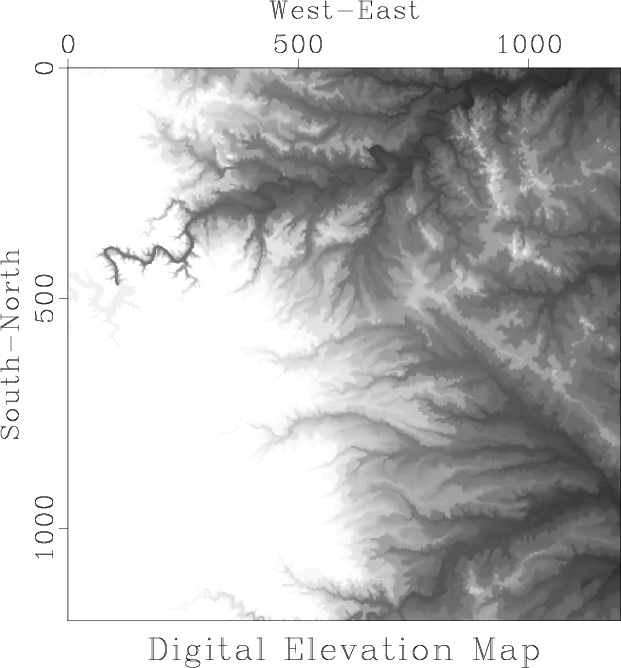
Figure 2. Digital elevation map of the west Austin area. |
|
|---|---|
![[scons]](icons/configure.png)
|
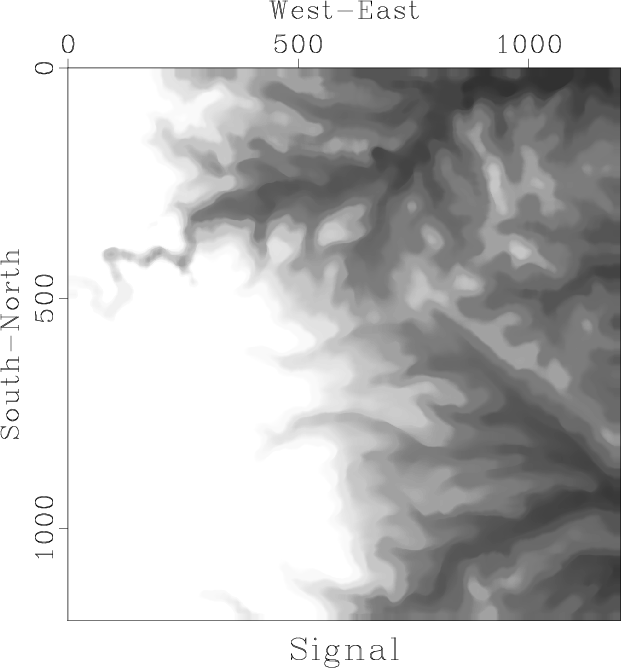
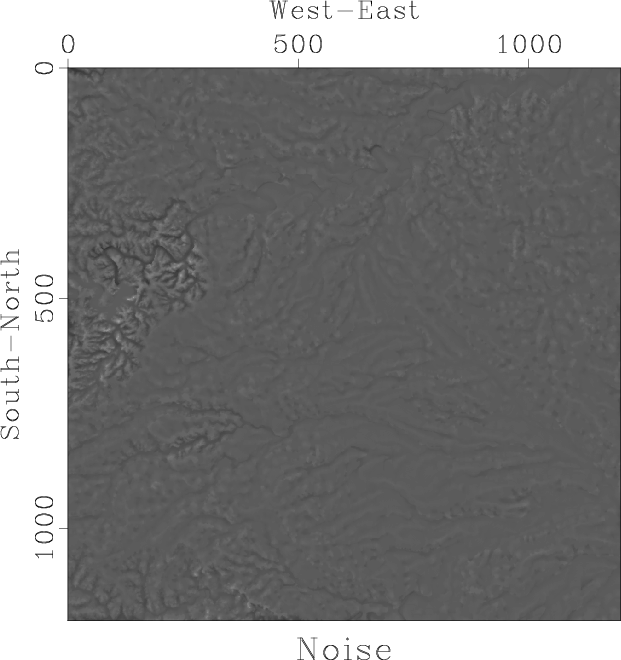
In this part of the homework, we will analyze the digital elevation map of the West Austin Area, shown in Figure 2. Our task is to separate the data into ``signal'' and ``noise'' by applying running mean and median filters. The result of applying a running median filter is shown in Figure 3. Running median effectively smooths the data by removing local outliers.
|
|---|
|
ave,res
Figure 3. Data separated into signal (a) and noise (b) by applying a running median filter. |
|
|
The algorithm is implemented in program running.c.
/* Apply running mean or median filter */

#include <rsf.h>

static float slow_median(int n, float* list)
/* find median by slow sorting, changes list */
{
    int k, k2;
    float item1, item2;

    for (k=0; k < n; k++) {
	item1 = list[k];

	/* assume everything up to k is sorted */
        for (k2=k; k2 > 0; k2-) {
            item2 = list[k2-1];
            if (item1 >= item2) break;
	    list[k2]   = item2;
	}
	list[k2] = item1;
    }

    return list[n/2];
}

int main(int argc, char* argv[])
{
    int w1, w2, nw, s1,s2, j1,j2, i1,i2,i3, n1,n2,n3;
    char *what;
    float **data, **signal, **win;
    sf_file in, out;

    sf_init (argc,argv);
    in = sf_input("in");
    out = sf_output("out");

    /* get data dimensions */
    if (!sf_histint(in,"n1",&n1)) sf_error("No n1=");
    if (!sf_histint(in,"n2",&n2)) sf_error("No n2=");
    n3 = sf_leftsize(in,2);

    /* input and output */
    data = sf_floatalloc2(n1,n2);
    signal = sf_floatalloc2(n1,n2);

    if (!sf_getint("w1",&w1)) w1=5;
    if (!sf_getint("w2",&w2)) w2=5;
    /* sliding window width */

    nw = w1*w2;
    win = sf_floatalloc2(w1,w2);

    what = sf_getstring("what");
    /* what to compute
       (fast median, slow median, mean) */
    if (NULL == what) what="fast";

    for (i3=0; i3 < n3; i3++) {

	/* read data plane */
	sf_floatread(data[0],n1*n2,in);

	for (i2=0; i2 < n2; i2++) {
	    s2 = SF_MAX(0,SF_MIN(n2-w2,i2-w2/2-1));
	    for (i1=0; i1 < n1; i1++) {
		s1 = SF_MAX(0,SF_MIN(n1-w1,i1-w1/2-1));

		/* copy window */
		for (j2=0; j2 < w2; j2++) {
		    for (j1=0; j1 < w1; j1++) {
			win[j2][j1] = data[s2+j2][s1+j1];
		    }}

		switch (what[0]) {
		    case 'f': /* fast median */
			signal[i2][i1] =
			    sf_quantile(nw/2,nw,win[0]);
			break;
		    case 's': /* slow median */
			signal[i2][i1] =
			    slow_median(nw,win[0]);
			break;
		    case 'm': /* mean */
		    default:
			/* !!! ADD CODE !!! */
			break;
		}
	    }
	}

	/* write out */
	sf_floatwrite(signal[0],n1*n2,out);
    }

    exit(0);
}
|
scons viewto reproduce the figures on your screen.
scons time.vplto display a figure that compares the efficiency of running median computations using the slow sorting from function median in program running.c and the fast quantile algorithm (library function sf_quantile ). Your goal is to make the algorithm even faster. You may consider parallelization, reusing previous windows, other fast sorting strategies, etc.
from rsf.proj import *

# Download data
Fetch('austin-w.HH','bay')

# Convert format
Flow('dem','austin-w.HH','dd form=native')

# Display
def plot(title):
    return '''
    grey clip=250 allpos=y title="%s"
    screenratio=1
    ''' % title

Result('dem',plot('Digital Elevation Map'))

# Running median program
run = Program('running.c')

w = 30

# !!! CHANGE BELOW !!!
Flow('ave','dem %s' % run[0],
     './${SOURCES[1]} w1=%d w2=%d what=fast' % (w,w))
Result('ave',plot('Signal'))

# Difference
Flow('res','dem ave','add scale=1,-1 ${SOURCES[1]}')
Result('res',plot('Noise') + ' allpos=n')

#############################################################

import sys

if sys.platform=='darwin':
     gtime = WhereIs('gtime')
else:
     gtime = WhereIs('gtime') or WhereIs('time')

if not gtime:
    print '''
For computing CPU time, please install GNU time!
    '''

# slow or fast
for case in ('fast','slow'):

    ts = []
    ws = []

    time = 'time-' + case
    wind = 'wind-' + case

    # loop over window size
    for w in range(3,16,2):
        itime = '%s-%d' % (time,w)
        ts.append(itime)

        iwind = '%s-%d' % (wind,w)
        ws.append(iwind)

        # measure CPU time


        Flow(iwind,None,'spike n1=1 mag=%d' % (w*w))
        Flow(itime,'dem %s' % run[0],
             '''
             ( (%s -f "%%S %%U"
             ./${SOURCES[1]} < ${SOURCES[0]}
              w1=%d w2=%d what=%s > /dev/null ) 2>&1 )
              > time.out &&
             (tail -1 time.out;
              echo in=time0.asc n1=2 data_format=ascii_float)
              > time0.asc &&
             dd form=native < time0.asc | stack axis=1 norm=n
             > $TARGET &&
             /bin/rm time0.asc time.out
             ''' % (gtime,w,w,case),stdin=0,stdout=-1)

    Flow(time,ts,'cat axis=1 ${SOURCES[1:%d]}' % len(ts))
    Flow(wind,ws,'cat axis=1 ${SOURCES[1:%d]}' % len(ws))

    # complex numbers for plotting
    Flow('c'+time,[wind,time],
         '''
         cat axis=2 ${SOURCES[1]} |
         transp |
         dd type=complex
         ''')

# Display CPU time
Plot  ('time','ctime-fast ctime-slow',
       '''
       cat axis=1 ${SOURCES[1]} | transp |
       graph dash=0,1 wanttitle=n
       label2="CPU Time" unit2=s
       label1="Window Size" unit1=
       ''',view=1)

End()
|
|
|
|
|
| Homework 2 | |
|